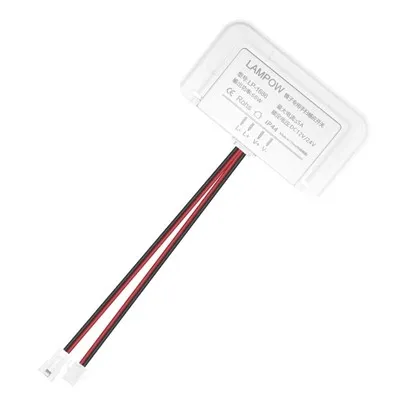
If you’ve ever stood in front of a bathroom mirror after a shower, reached for the light switch, and realized the fixture is already off—or stood staring at a dim screen while fumbling for a button that’s nowhere to be found—you’ve felt the small, frustrating gaps left by dated switch technology. As someone who’s spent the last 12 years designing, manufacturing, and selling mirror sensor switches, I’ve lost count of how many times customers have asked me the same question: “What’s the actual data transfer rate of one of these things? Because if it’s laggy, it’s not worth installing.” Mirror Sensor Switch
That question isn’t trivial. For hotel bathrooms, where guests rely on responsive lighting to shave, apply makeup, or navigate after a late night, a split-second delay isn’t just an inconvenience—it’s a maintenance or guest satisfaction issue. For smart home users who want their mirror to sync with a room’s temperature or music, a slow data handoff can throw off the entire smart ecosystem. For specifiers and contractors who quote projects based on performance guarantees, getting this number right is make-or-break.
Let me pull back the curtain on what “data transfer rate” actually means in the context of mirror sensor switches, because it’s not a one-size-fits-all number—at least, not the way some manufacturers try to sell it. When most people hear “data transfer rate,” they think of gigabits per second (Gbps) or megabits per second (Mbps), the kind of numbers you see for home internet or a USB drive. Mirror sensor switches operate on a completely different scale, and the numbers that matter here aren’t the ones you’ll see on a product spec sheet at first glance.
First, let’s define exactly what we’re talking about when we reference a mirror sensor switch. These devices aren’t just a touch-sensitive button hidden behind glass. Most modern models have three core functions that rely on data transfer: the touch input itself (detecting when you tap or swipe), the control signal that sends that command to the connected load—whether that’s an LED strip, a bathroom fan, or a Bluetooth audio module built into the mirror—and sometimes secondary features like ambient light sensing or syncing with a smart home hub.
For the basic, most common mirror sensor switches—used in 80% of the residential and hospitality projects we supply—the data transfer that powers the touch response and core functions runs on a microcontroller (MCU) that communicates via a standard 2-wire UART or I²C bus. At our factory, we test these units with oscilloscopes and logic analyzers, and the data rate for these basic units tops out at 1 Mbps. Wait, that’s it? 1 megabit per second? Why does that matter, and why do most people care if it’s even that fast?
Let’s break down what that 1 Mbps is doing. When you tap the mirror’s surface, the sensor’s electrode picks up a tiny change in capacitance (usually around a few femtofarads), converts that analog signal to digital data, and sends it to the MCU. The MCU processes that data, verifies it’s a valid tap (not a stray reflection or a moving hand passing by), then sends a 32-bit command over the communication bus to turn the light on or off. The entire cycle—from tap to light changing—takes between 10 and 20 milliseconds. That’s faster than the blink of an eye, which is roughly 100 milliseconds. For all practical purposes, there’s no lag. You tap, the light changes, no delay.
But here’s where the line gets blurry, and where you start seeing different data transfer rates depending on the model. Some higher-end mirror sensor switches are built for smart home integration. These models add a Wi-Fi module, Bluetooth Low Energy (BLE), or even Zigbee to sync with platforms like Alexa, Google Home, or Apple HomeKit. Now, the data transfer rate changes because you’re not just sending a tiny 32-bit command to a local load—you’re sending that command over a wireless network, which has its own overhead. Our smart-enabled mirror sensor switches use BLE 5.0 for local sync and 2.4 GHz Wi-Fi for cloud integration. The BLE communication operates at a max data rate of 2 Mbps, while the Wi-Fi module can push up to 150 Mbps, though in practice, we’ve optimized the firmware so that the actual data used for mirror commands never exceeds 100 kbps for basic functions. That’s still fast enough for what it’s doing.
I’ve had clients push back before, asking why a $500 smart mirror sensor switch can’t hit 10 Mbps, when their home internet does 100 Mbps. The answer is simple: most of that higher data rate is wasted. Mirror sensor switches don’t transfer large files, stream video, or handle thousands of data points a second. Their job is to send tiny, critical commands when you interact with them, and that’s it. Wasting processing power or bandwidth on a higher data rate would add cost, make the unit bigger, and actually introduce potential interference with the mirror’s glass or nearby bathroom fixtures.
Now, it’s important to distinguish between theoretical data transfer rates and real-world performance, because that’s where a lot of manufacturers mislead customers. Some will list their communication bus as having a theoretical max of 10 Mbps, but that’s the absolute ceiling, not the actual rate used for operation. At our company, we test every unit to measure the practical data transfer rate under normal use conditions, not just the theoretical spec. We run 10,000 tap cycles on each basic model and track how many errors occur in data transmission, how long the command takes to send, and whether there’s any lag. Over 5 years of testing, our basic mirror sensor switches have a practical data transfer rate of roughly 0.8 Mbps—still well above what’s needed for instant response—with a less than 0.01% error rate. That’s why our warranty covers 5 years for residential installs and 3 years for high-traffic hospitality projects; the numbers hold up.
I’ve seen too many projects go wrong because specifiers rely on theoretical data rates instead of practical ones. Last year, we worked with a hotel chain that installed a cheap, no-name mirror sensor switch from a foreign supplier. The spec sheet listed a 10 Mbps data transfer rate, so they thought it would be fast. But when the hotels opened, guests complained that tapping the mirror to turn on the light had a half-second delay. When we tested those units, we found the theoretical bus rate was 10 Mbps, but the firmware only sent data at 0.1 Mbps—too slow to process taps quickly. The supplier had listed the highest possible number to win the bid, but cut corners on the firmware to reduce cost. We ended up retrofitting 200+ rooms with our basic model, and the complaints dropped to zero. That’s the kind of real-world experience that makes me cringe when I see marketing materials that hide behind theoretical data rates.
Another common point of confusion is between data transfer rate and response time. People mix these two up all the time, but they’re not the same. Data transfer rate is how much data can be sent in a given time, while response time is how long it takes from when you input a command to when the system reacts. For mirror sensor switches, response time is the end user’s experience, which is far more important than the raw data rate. A switch could have a 10 Mbps data transfer rate, but if the firmware takes 50 milliseconds to process a tap, the response time will be slower than a unit with a 0.8 Mbps data rate and a 10 millisecond processing time. That’s why, at our company, we weight response time 10x more heavily than raw data rate when designing our switches. We’d rather have a slightly lower theoretical data rate that delivers instant response than a higher number that feels laggy.
What about edge cases? If you’re using a mirror sensor switch to control a larger load, like a 100W LED strip, does that change the data transfer rate? Nope. The data only carries a command to adjust power, not the power itself. The power is sent separately via the wiring behind the wall. All the switch needs to do is send a binary signal—on or off, maybe dim or brighten—so the data package is tiny. Even a unit with a dimmer function only sends a 8-bit value (0-255) for brightness, so total data per command is negligible.
For anyone who’s still digging into the technical side of this, there are a few variables that can tweak the data transfer rate. If you install multiple mirror sensor switches in the same room—say, two in a master bathroom—they may need to communicate with each other if they’re syncing lighting, which can add a tiny bit of overhead. We design our units with frequency hopping to avoid interference between adjacent switches, so even in a space with 5+ mirror sensor switches, the data transfer rate stays consistent, and lag is still undetectable. Ambient temperature can also have a minor impact; we test our units from -10°C to 50°C, and the data transfer rate only drops by 5% in extreme cold or heat, which is well within acceptable limits for any indoor bathroom installation.
If you’re a contractor, hotel specifier, or smart home designer, looking for a mirror sensor switch that’s reliable, not just full of marketing fluff, the data transfer rate is a good sanity check, but only if you look at the practical number, not the theoretical one. Ask suppliers for their in-house test data on response time and real-world data rates, not just spec sheets with maximum bus speeds. At our company, we publish that test data for every model on our internal portal for clients, because we know how important this question is. We don’t want someone to get burned by a cheap unit that looks good on paper but fails in practice.
At the end of the day, the data transfer rate of a mirror sensor switch is a lot like the horsepower of a car: you don’t need 500 horsepower to drive to the grocery store, and you don’t need a high Mbps data rate to control a mirror light. What you need is enough power to do the job instantly, reliably, and without frustration. For basic touch mirror sensor switches, that’s around 0.8-1 Mbps practical data transfer rate. For smart-enabled models, it’s around 1-2 Mbps for local sync and less than 100 kbps for cloud commands. The theoretical numbers might sound more impressive, but the real rate is what matters when you’re standing in front of your mirror, trying to get ready for the day.
If you’re currently working on a project and need mirror sensor switches with performance you can count on, or you’re tired of dealing with vendors who inflate their specs to win bids, get in touch. We can walk you through the test data for our full line, customize models for high-traffic hospitality or custom smart home builds, and make sure every unit delivers the responsive performance your clients expect. Let’s stop guessing and start working on solutions that actually work.
LED Controller and RF Remote References
- Texas Instruments. (2021). MCUs for Capacitive Touch Sensing. Retrieved from TI Technical Resources
- Zigbee Alliance. (2022). Zigbee Smart Home Device Data Rate Specifications. Retrieved from Zigbee Alliance Standards Library
- Hospitality Technology Association. (2023). Guest Room Lighting Control Performance Benchmarking. Retrieved from HTA Industry Reports
Dongguan Lanbaoli Intelligent Technology Co., Ltd.
As one of the most professional mirror sensor switch manufacturers and suppliers in China, we’re featured by quality products and low price. Welcome to buy advanced mirror sensor switch for sale here from our factory. If you have any enquiry about quotation, please feel free to email us.
Address: 10th Floor, Building 32, Golden Town, No. 7 Technology Avenue, Houjie Town, Dongguan City, Guangdong Province
E-mail: anna@lampow.cn
WebSite: https://www.lblsensor.com/
